A trade show tablecloth is not really a tablecloth. It is a piece of branding that happens to cover a table — the surface your visitors see first, the backdrop for your samples, and often the only place your logo appears at eye level. Order the wrong style or size and you get pooling fabric, exposed table legs, and a booth that looks improvised. Order it right, and a simple table becomes a professional stand. This guide covers the styles, sizing, printing, and buying decisions that matter when you order in bulk.
1. Why Event Tablecloths Are a Different Product
Event and exhibition table covers differ from dining linens in four important ways: they are sized to standard display tables rather than dining tables, they are designed to cover the table to the floor (or fit it like a second skin), they are usually printed with full-color branding, and they must survive being folded, transported, and reused dozens of times a year. Buying them is a marketing decision as much as a textile one.
2. Standard Table Sizes You Will Be Quoting Against
Most exhibition and event tables follow one of two standard sizes, and covers are specified by table size plus style:
| Table | Length | Width | Height | Typical cover styles |
|---|---|---|---|---|
| Standard 6 ft display table | 72″ (183 cm) | 30″ (76 cm) | 29″ (74 cm) | Throw (3 or 4-sided), fitted, stretch |
| Standard 8 ft display table | 96″ (244 cm) | 30″ (76 cm) | 29″ (74 cm) | Throw (3 or 4-sided), fitted, stretch |
| Tall cocktail table | 24–32″ (61–81 cm) | 24–32″ (61–81 cm) | ~42″ (107 cm) | Stretch cover, round or square |
Always specify by table size and cover style rather than by an approximate fabric measurement — a “6 ft fitted, 4-sided” cover and a “6 ft throw” are different products, and a fraction of an inch matters when the fabric has to reach the floor.
3. Three Main Styles
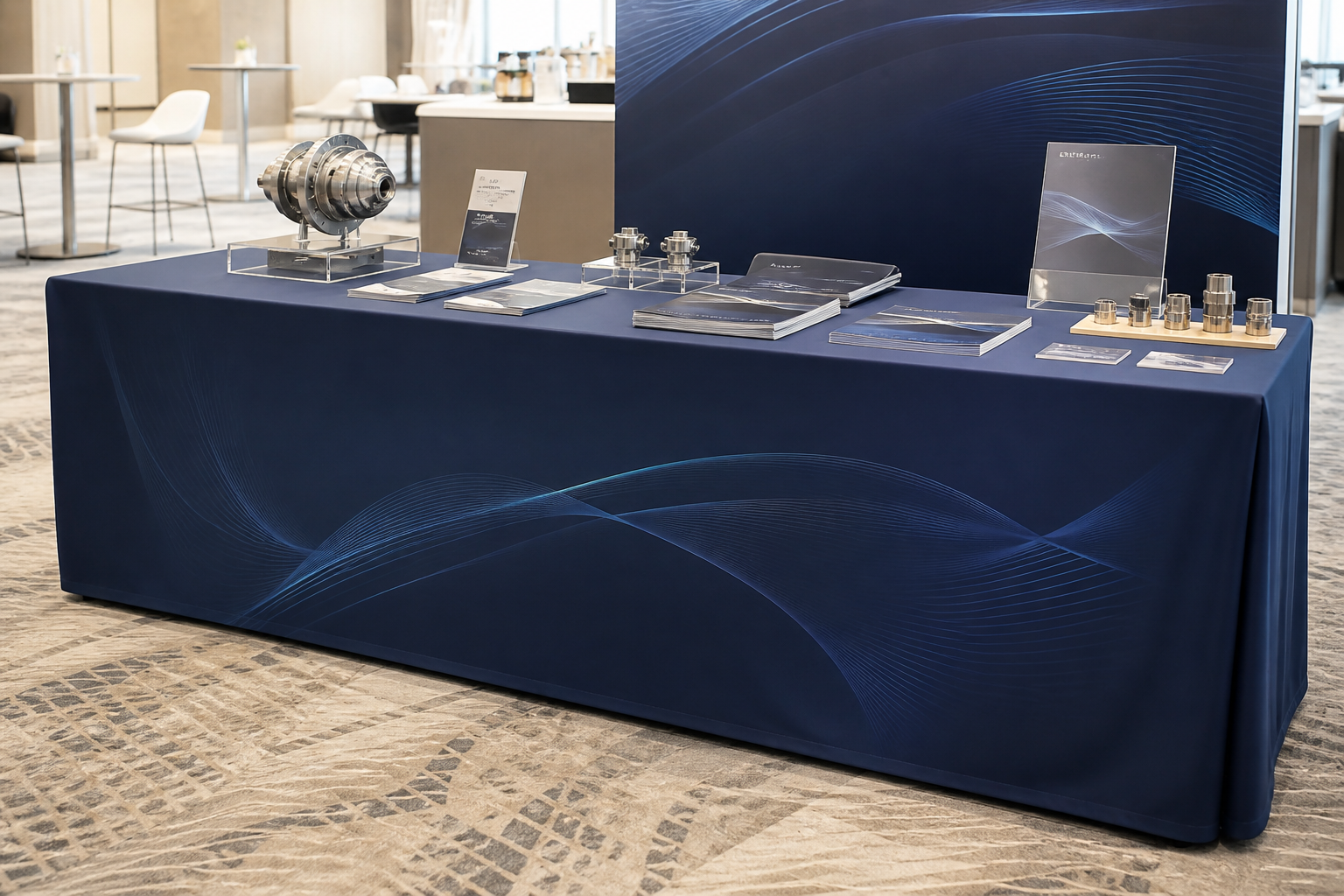
- Table throw (draped): The classic open-backed cover. A 4-sided throw covers all four sides to the floor; a 3-sided throw leaves the back open so staff can sit behind the table. Easiest to print large, fastest to set up.
- Fitted cover: Tailored to the table’s exact dimensions, with seamed corners and a snug fit. It looks the most polished and never shifts during the event, but it must match the table precisely.
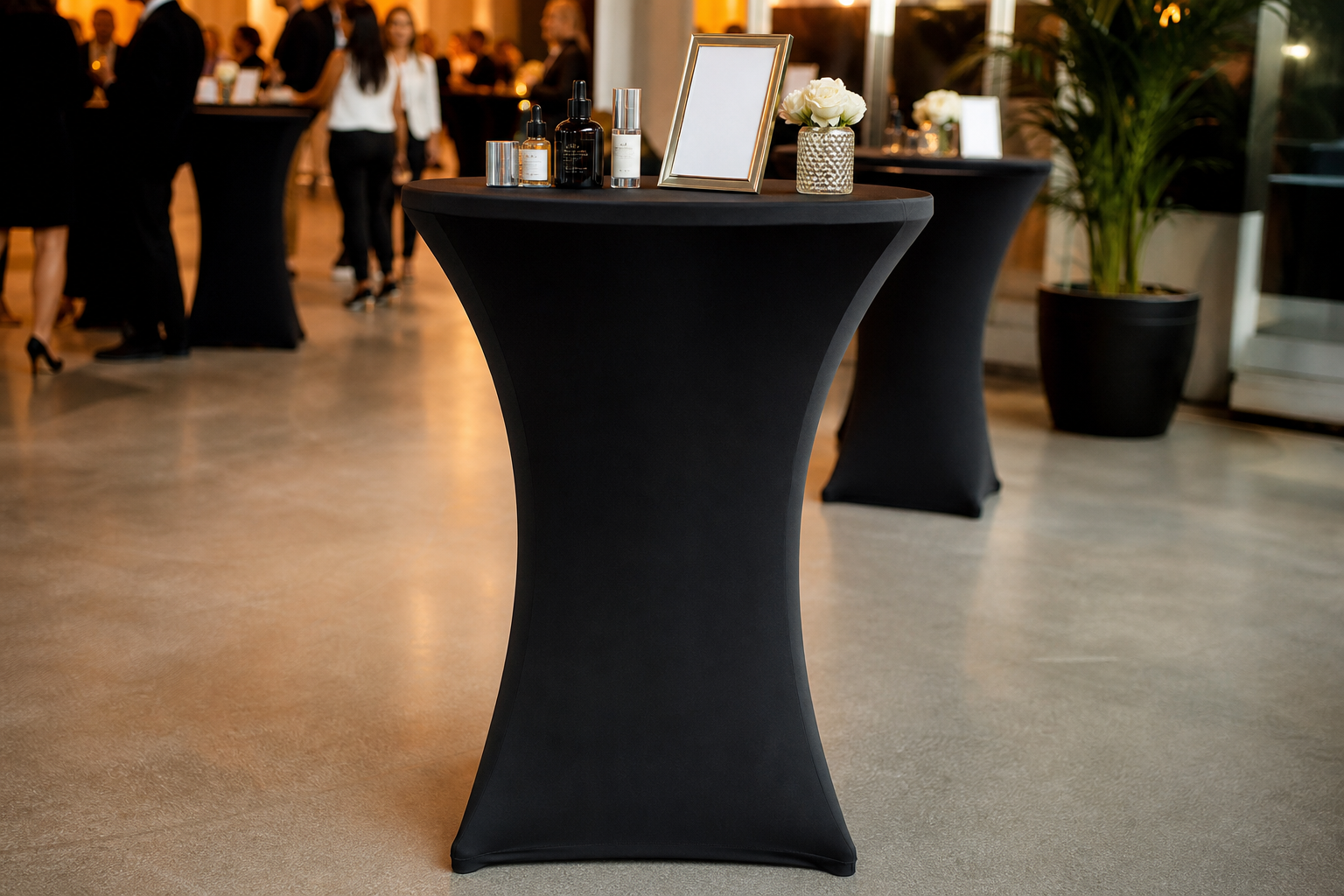
- Stretch cover: Made from a stretchable polyester that pulls over the table like a sock, giving a smooth, seamless, tensioned surface with no wrinkles. The modern choice for sleek corporate booths — and the best option when you want an edge-to-edge printed graphic.
4. Printing Methods
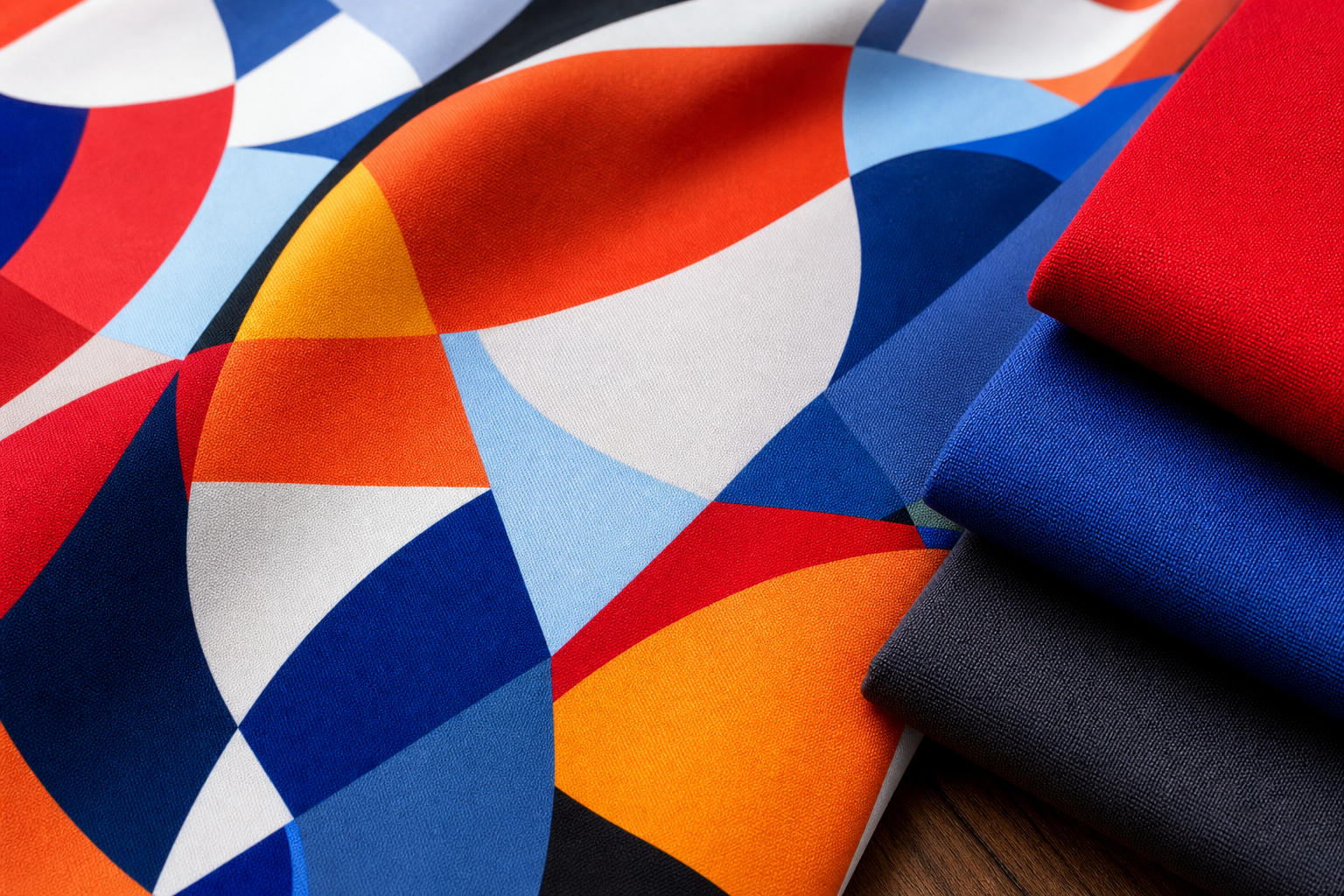
- Dye-sublimation (full-color): The standard for event covers. Ink is heat-bonded into polyester fibers, producing vibrant photographic graphics that do not crack or peel. Ideal for gradient artwork, photos, and multi-color logos.
- Screen printing: Best for simple, bold spot-color designs in higher volumes; color separation is needed, so it suits a limited palette.
- Embroidery: For a premium, tactile brand mark on solid-color covers. Embroidery is usually limited to one or two colors and a defined size.
Whatever the method, ask for a digital proof before production and a physical sample for a first order. Color-matching between your screen and the printed fabric is the single most common source of disappointment in bulk orders.
5. Fabric Choices
- Stretch polyester (for stretch covers): Thick, resilient, and wrinkle-resistant, with high opacity so the table does not show through the print.
- Spun polyester (for throws and fitted covers): A durable, cotton-feeling fabric that prints well, resists creasing in transit, and is easy to care for.
- Wrinkle-resistant treated fabrics: A practical upgrade for teams that transport covers in bags and set up minutes before doors open.
6. Buying in Bulk: What to Confirm Before Ordering
- Table dimensions in writing. Confirm length, width, and height — including whether the back must stay open for staff seating.
- Print file quality. Supply vector artwork or high-resolution files with defined color references; confirm bleed and how the graphic wraps around corners.
- Sample first, then scale. Order one proof cover before committing to a full run, especially for multi-booth or multi-city programs.
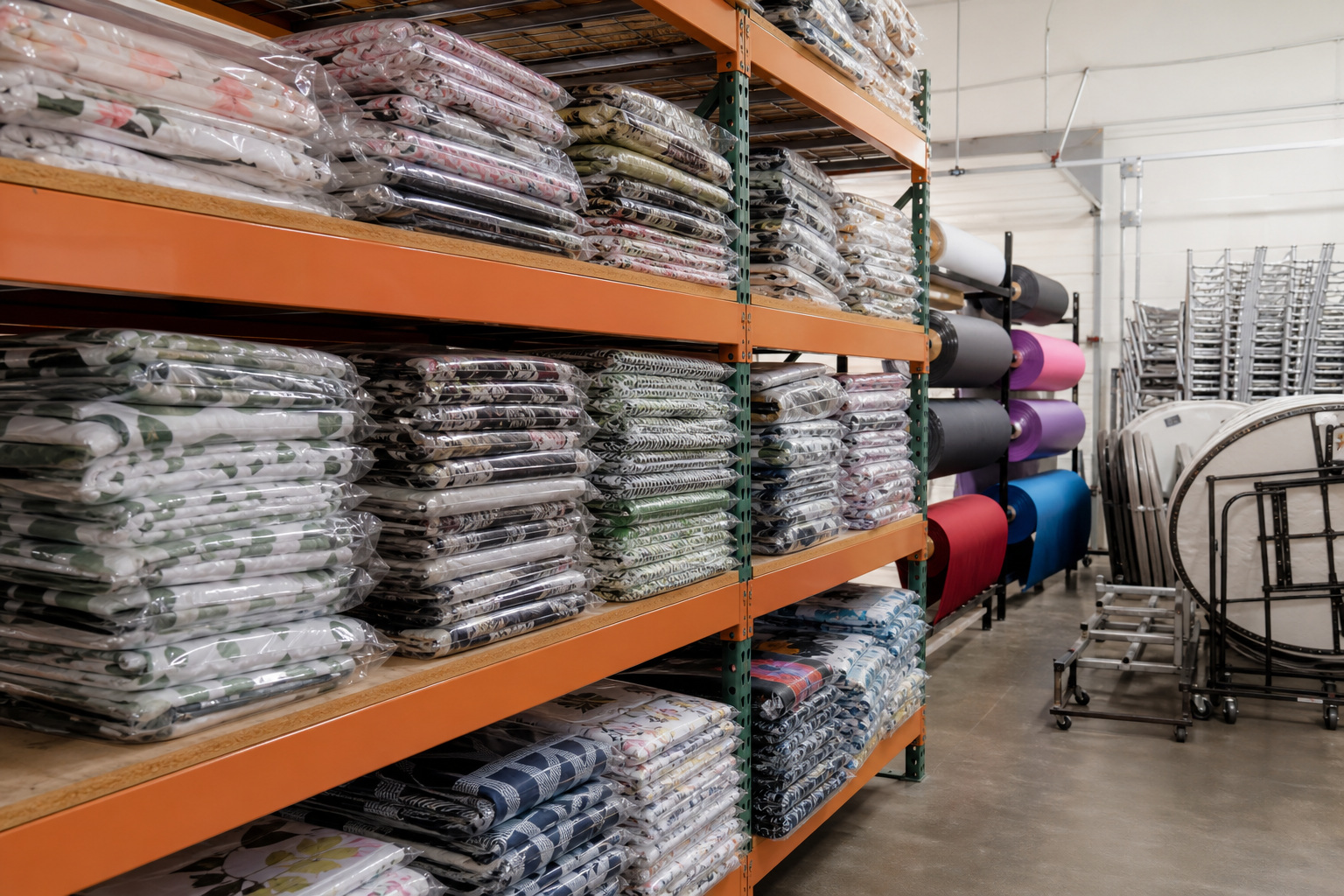
- Plan for the logistics. Ask how covers are folded and packed — consistent folding protects the print and speeds up setup on site.
- Consider matching your booth. Table covers, banners, and backdrop walls are often ordered together; a coordinated set looks intentional and usually saves on shipping.
- Budget for replacements. Covers get handled roughly. Order spares for your busiest event months rather than reordering at short notice.
7. Care and Reuse
- Fold, do not wad. Fold along the same lines each time to keep the cover sitting flat on the table.
- Follow the wash care for the print. Dye-sublimated polyester can usually be machine washed cool and tumble dried low; avoid bleach and fabric softener.
- Never iron directly on a print. Low heat from the reverse side, or steam, protects the print surface.
- Store rolled for long breaks. For off-season storage, rolling reduces permanent creases more reliably than folding.
8. Event Tablecloth FAQs
Should I choose a throw or a fitted cover?
Choose a 3-sided throw if staff need to sit behind the table; choose a 4-sided throw or fitted cover if the back of the table is visible to visitors. Fitted covers look the most tailored; throws print the largest graphic area most economically.
Can I put a full-color photo on a table cover?
Yes — dye-sublimation printing reproduces photographs and gradients well on polyester covers. Provide high-resolution artwork and request a proof before the production run.
How many covers should we order?
Plan one cover per table, plus spares for your peak season and for any multi-city event program. Teams exhibiting monthly usually keep two or three spares per size.
Do printed covers fade over time?
Dye-sublimated printing is durable and resists cracking and peeling, but repeated high-heat washing and direct sunlight will gradually soften colors. Cool washing and careful storage keep the print strong for years.
Final Thoughts
Event tablecloths sit at the intersection of textile and marketing — which is exactly why they deserve proper specification rather than a last-minute purchase. Match the style to how you use the table, print with a method suited to your artwork, and confirm dimensions in writing. Then the cover simply does its job: making your booth look like the professional operation it is.
We manufacture table covers for events, exhibitions, and hospitality — throws, fitted covers, and stretch covers with full-color dye-sublimation printing, embroidery, and custom sizing. Contact us for samples, artwork guidelines, MOQs, and wholesale pricing.