Pleating is the part of a table skirt that most people see and few people understand. It is what separates a skirt that reads as formal from one that reads as improvised — and it is also where the fabric cost hides, because a pleated skirt consumes a multiple of its finished length. For a buyer, “pleated” should be a set of specific decisions: which pleat, at what depth, held by what method, in which fabric. This guide covers those four decisions.
1. Why Pleated Skirts Lead Formal Settings
- Structure reads as intention. A regular, held pleat says the table was styled; a flat or loosely gathered panel says it was covered. In reception, ceremony and formal banquet settings, that signal is the whole job.
- Pleats order the light. Each fold makes a shadow line, so a pleated skirt has rhythm and depth that a flat surface cannot — which is why it photographs and reads as premium.
- The fold conceals and protects. Pleating gives the fabric a little slack built in, so the skirt tolerates minor table-size variation better than a taut flat panel.
- It is the highest-value upgrade. Of all the options on a skirt — fabric, size, edge — pleating is the one that most visibly lifts the price point of the whole table.
2. The Three Pleat Styles
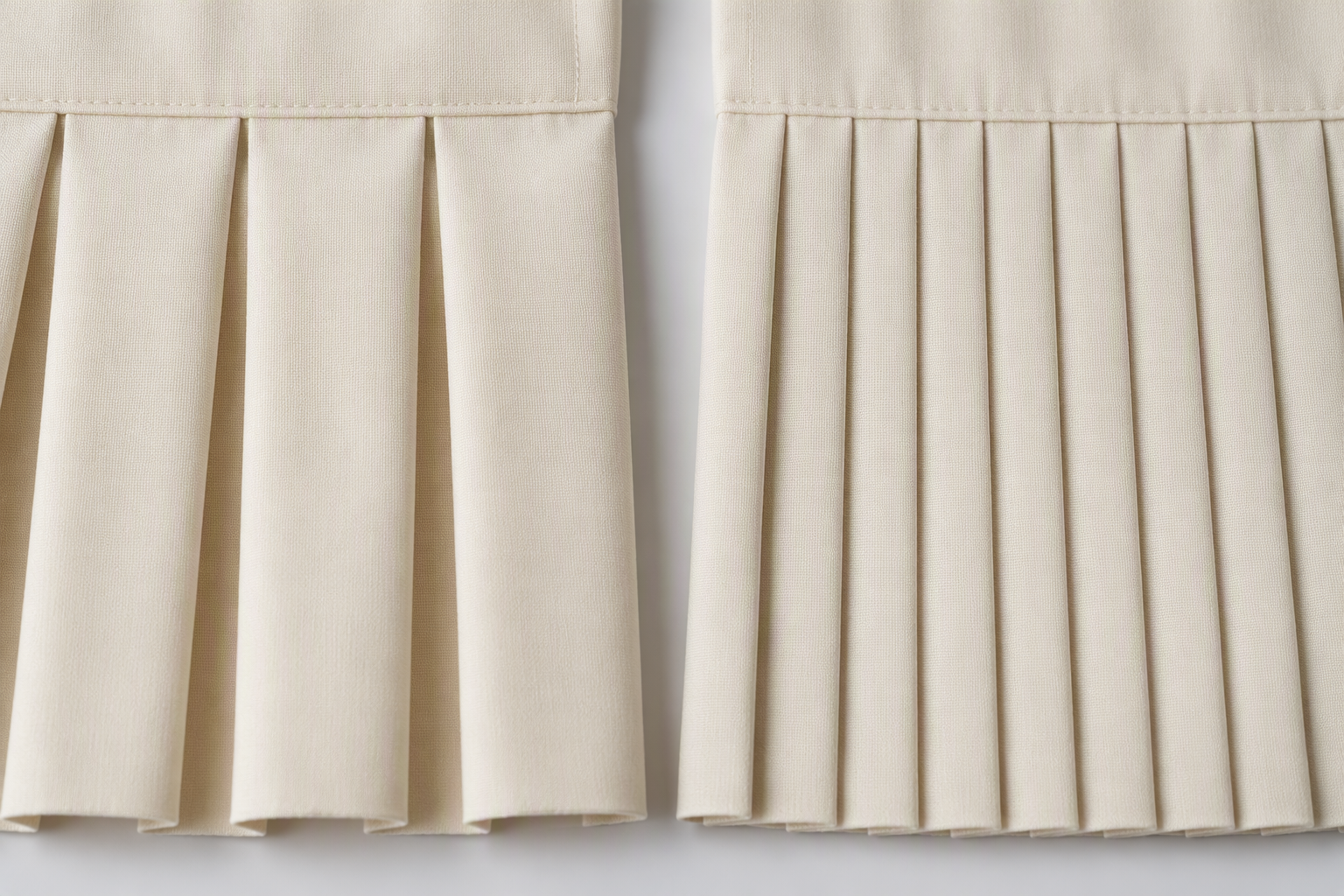
- Box pleat (accordion): folds alternate outward and inward, creating a series of flat rectangular panels joined by crisp valleys. The standard for formal and celebratory use — the cleanest, most structured look, and the one people mean when they say “pleated.” Most fabric-intensive of the three.
- Knife pleat: all folds run the same direction, producing a flatter, lighter, more linear surface with a subtle striped rhythm. Reads as more modern and less formal than box pleat, and uses slightly less fabric. Popular for contemporary venues and styled settings.
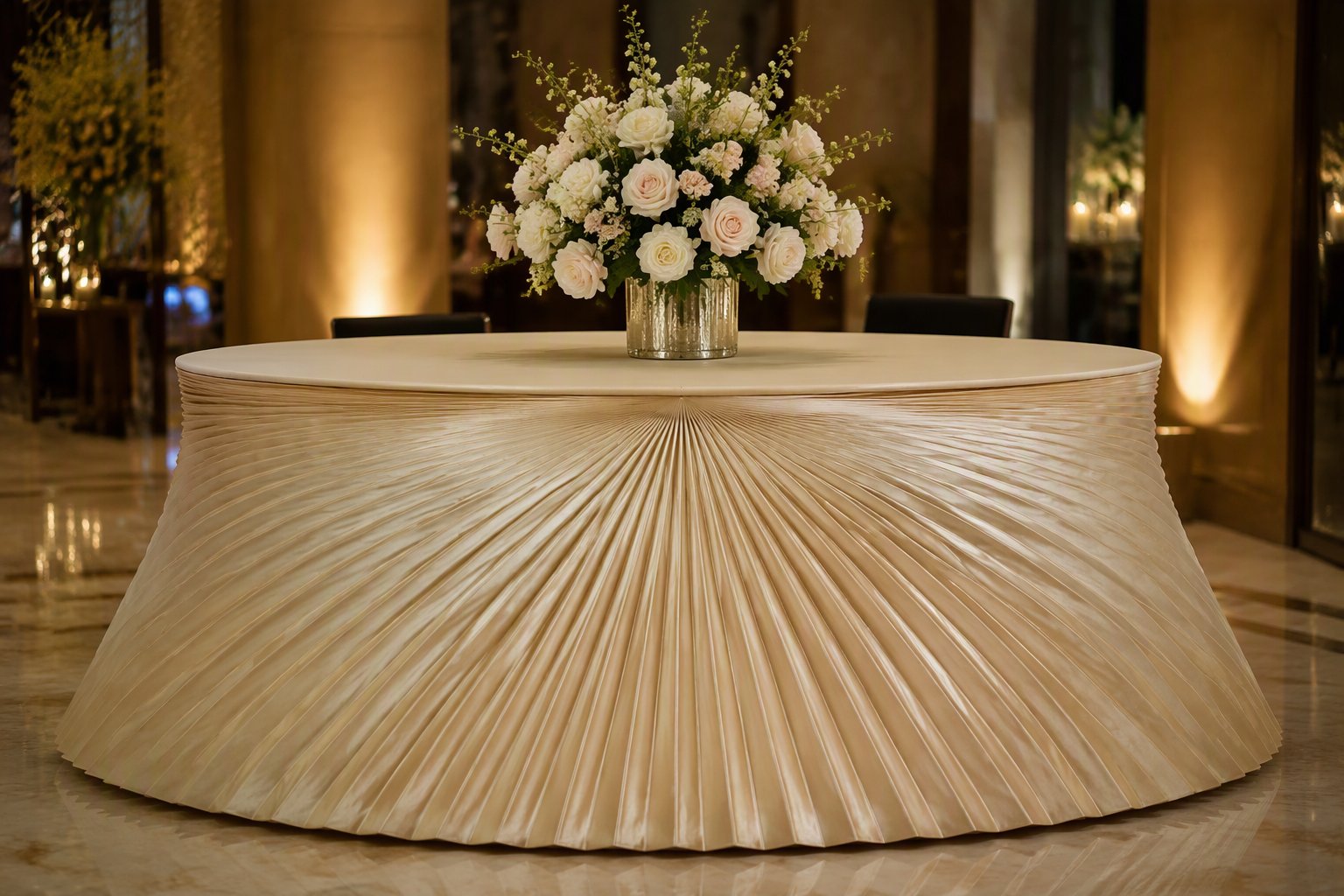
- Sunray (fan) pleat: pleats radiate outward from a centre point — the signature finish for round reception desks, podiums, and altar tables, where the radial pattern follows the table’s shape. Visually the most decorative of the three.
3. Pleat Ratio: How Much Fabric a Pleated Skirt Really Uses
The pleat ratio is the relationship between the raw fabric length used and the finished length the skirt spans. A flat skirt uses roughly 1:1 (plus seam and hem allowances); a pleated skirt uses a multiple of the finished length, because every fold consumes width.
- Box pleats run the highest ratio — the alternating folds need the most fabric per unit of finished length, which is why a box-pleated skirt costs more than a flat one of the same finished size, even in the same fabric.
- Knife pleats sit a little lower, because the one-direction folds pack tighter.
- Deeper pleats use more fabric — a skirt specified with a large pleat depth consumes more cloth per foot of table than one with a shallow pleat, even at the same style.
- Worked example: for a 60″ table run, a flat skirt uses about 60″ of fabric (plus allowances); the same 60″ finished as a box-pleated skirt uses a multiple of that raw length depending on the pleat depth and ratio specified. The finished size is what you see; the ratio is what you pay.
That is why “pleated” must be specified precisely: the same finished skirt can be made with different ratios, and the ratio drives both the cost and the fullness of the look. Two suppliers quoting the same “pleated skirt” can be building different things.
4. Pleat Depth and the Level of Formality
- Deep box pleats give the full, formal, traditional look — the classic reception and ceremony finish, with strong shadow lines and a substantial drape.
- Shallow pleats read as lighter and more modern — still structured, but closer to a textured flat than a full pleat. Good for contemporary venues that want rhythm without formality.
- Match the depth to the drop: a floor-length skirt with deep pleats is the most formal combination; a mid-drop skirt with shallow pleats is the most contemporary. The two choices should be made together, not independently.
5. How the Pleats Are Held
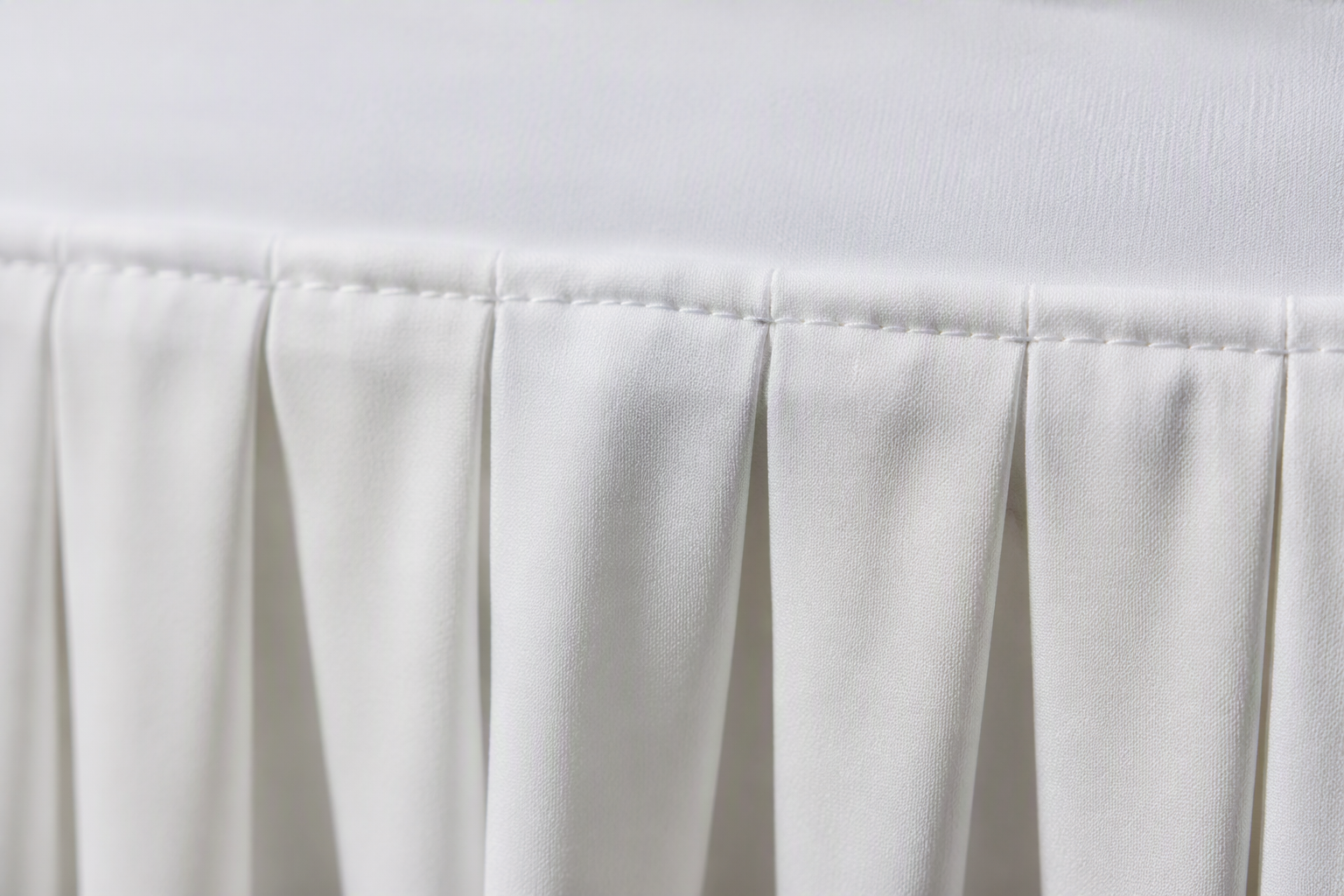
- Stitched header (top stitching): the pleats are pinned and sewn along a header at the top edge, then the header is attached to the table. The most secure and formal method — the pleats cannot migrate. The stitching quality is a direct quality marker.
- Heat-set / thermally bonded pleats: the crease is set with heat so the folds hold without heavy stitching. Lighter look, but the set can relax over many washes.
- Adhesive or hook-and-loop backing: the pleated panel is fixed along the top with adhesive or hook-and-loop tape. Easier to install and remove; the holding is less visible but less permanent — right for venues that swap skirts often.
- Clips or channels: the skirt is gathered into a channel or clipped to the table edge. The most adjustable, but the least formal — the top line shows the attachment method more than it hides it.
The holding method is a specification, not a default. It decides how clean the top line looks, how often the skirt can come off and go back on, and how well the pleats survive a program of washing — so it should be stated in the order and confirmed on the sample.
6. Choosing Fabric for Pleating
- Taffeta is the benchmark: crisp enough to hold a sharp pleat, with the sheen that makes the fold lines read. Box-pleated taffeta is the classic formal combination.
- Polyester pleats well and is the practical, easy-care choice for high-turnover commercial use — a little less crisp than taffeta, far more forgiving.
- Satin / sateen pleats with more drape and less structure — the folds read softer, which suits styled and romantic settings over rigid formality.
- Linen-look pleats with a matte, textured result — a softer, more modern formality that suits contemporary and home-styled programs.
- The rule: the stiffer the fabric, the sharper the pleat holds; the softer the fabric, the gentler and less rigid the look. Pick the fabric and the pleat together.
7. Quality Checks on a Pleated Skirt
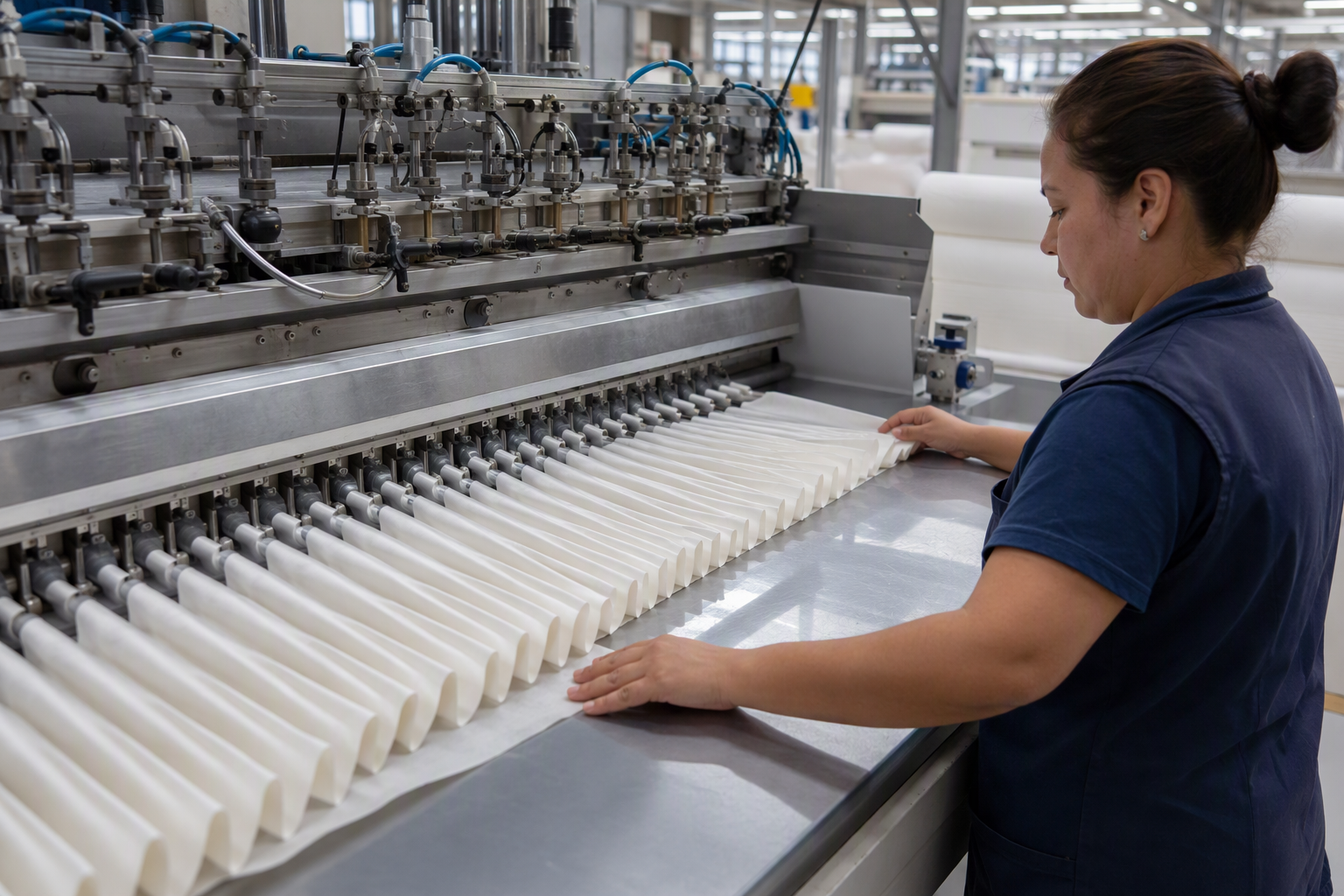
- Pleat evenness: the folds should run at a consistent depth and spacing from top to hem. A pleat that drifts, tightens, or loosens down the length is a workmanship defect and the first thing a critical eye finds.
- Sharp, clean fold lines: each valley should sit crisp, not rolled or blurred. Blurred pleats usually mean the fabric or the press did not hold the set.
- Even top holding: the header or attachment line should be level and the pleats evenly distributed along it — an uneven top is the most visible failure point.
- Matched hem line: floor-length in particular should have an even hem at the foot; a short corner shows immediately.
- Approval on the table, not flat: a pleated skirt read on the flat hides how the folds sit once draped — the sample should be approved fitted on the real table under the venue light.
8. Specifying Pleated Skirts in an Order
- Name the pleat style — box, knife, or sunray — and the intended table shape (a sunray on a straight run will not behave as designed).
- State the pleat depth and the finished size separately — the depth drives the ratio and the look; the finished size drives the fit.
- Specify the holding method — stitched header, heat-set, adhesive, or channel — so the top line is what you expect.
- Confirm the fabric and its pleat behaviour on the sample — the same pleat in taffeta and in a soft satin is a different product.
- Approve a fitted sample before production, and match the dye lot across the full run — a pleated skirt shows a colour or workmanship shift across a row of tables more than a flat one ever would.
9. Care
- Follow the fabric’s care — taffeta and polyester on a cool/gentle cycle, mild detergent, no chlorine bleach.
- Store with the pleats, not against them — fold a pleated skirt so the folds lie together; creasing a pleat flat in storage is how a sharp skirt loses its structure.
- Steam to refresh before an event rather than hard-pressing, which can flatten the fold set and leave shine marks.
- Re-check the holding line over time — the top attachment takes the mechanical load, and a loosening header is the first sign a skirt needs attention or retirement.
10. Pleated Table Skirt FAQs
Box pleat or knife pleat — which looks more expensive?
Box pleat, in the right fabric and depth — the alternating folds and deeper shadow lines read as more formal and substantial. Knife pleat reads as more modern and lighter. “More expensive-looking” and “more formal” are not always the same thing, so match the pleat to the setting rather than to a price impression.
Why does a pleated skirt cost more than a flat one of the same size?
Because of the pleat ratio — the raw fabric is a multiple of the finished length, and the pleating itself is additional workmanship. You are paying for both the extra cloth and the process. A quote that treats a pleated and a flat skirt as the same price is one to question.
Can pleats be made in a soft fabric like satin?
Yes — but the result is different. A soft fabric gives a gentler, less rigid pleat with more drape. If the specification is a sharp, structured pleat, a crisp fabric like taffeta is the better match; if the goal is a soft, romantic fold, a softer fabric is deliberate, not a compromise.
How do I know the pleats will hold up over many washes?
By the holding method and the fabric. A stitched header is the most secure; a heat-set pleat can relax over time. Confirm the method on the sample, ask how the pleats are set, and check the holding line after a few washes in your own program before committing the full run.
Final Thoughts
A pleated table skirt is a specification in four parts: the pleat style, the depth and ratio, the holding method, and the fabric. Decide them together, not in isolation — the style to the setting and table shape, the depth to the formality you want, the holding to how often the skirt comes off, and the fabric to how sharp you need the fold to sit. Approve a fitted sample on the real table, check the evenness down the length, and specify the ratio in writing — and the skirt reads exactly as the room was designed to.
We produce box, knife, and sunray pleated table skirts in taffeta, satin, polyester, and linen-look fabrics, with the pleat depth, ratio, and holding method specified and sample-approved before production. Contact us for pleated skirt samples, pleat ratio guidance, MOQs, and wholesale pricing.