Printing is how a cloth napkin carries a pattern, a brand, or a seasonal look without the cost of woven decoration. It is also the part of a napkin program that fails most quietly: a print that looks perfect at approval can fade, bleed, or crack within a few washes if the method or the design was not chosen for the care cycle the venue actually runs. Getting the method and the design right is what separates a printed napkin program that stays sharp from one that looks tired after a season.
1. Why Choose Printed Napkins
- Pattern at fabric cost. A printed design delivers the visual impact of a woven or embroidered cloth at a specification level that suits volume programs.
- Brand and identity. Restaurants, hotels, and venues use printed napkins to carry a house pattern or brand look across every table at once.
- Seasonal flexibility. New seasons and events are easier to run as a printed accent than as a re-woven program — the base cloth stays constant, the print changes.
- Colour range. Printing reaches colours and multi-colour designs that would be impractical to weave or embroider at the same specification.
2. The Printing Methods Compared
| Method | How it works | Colour range & detail | Wash durability | Best for |
|---|---|---|---|---|
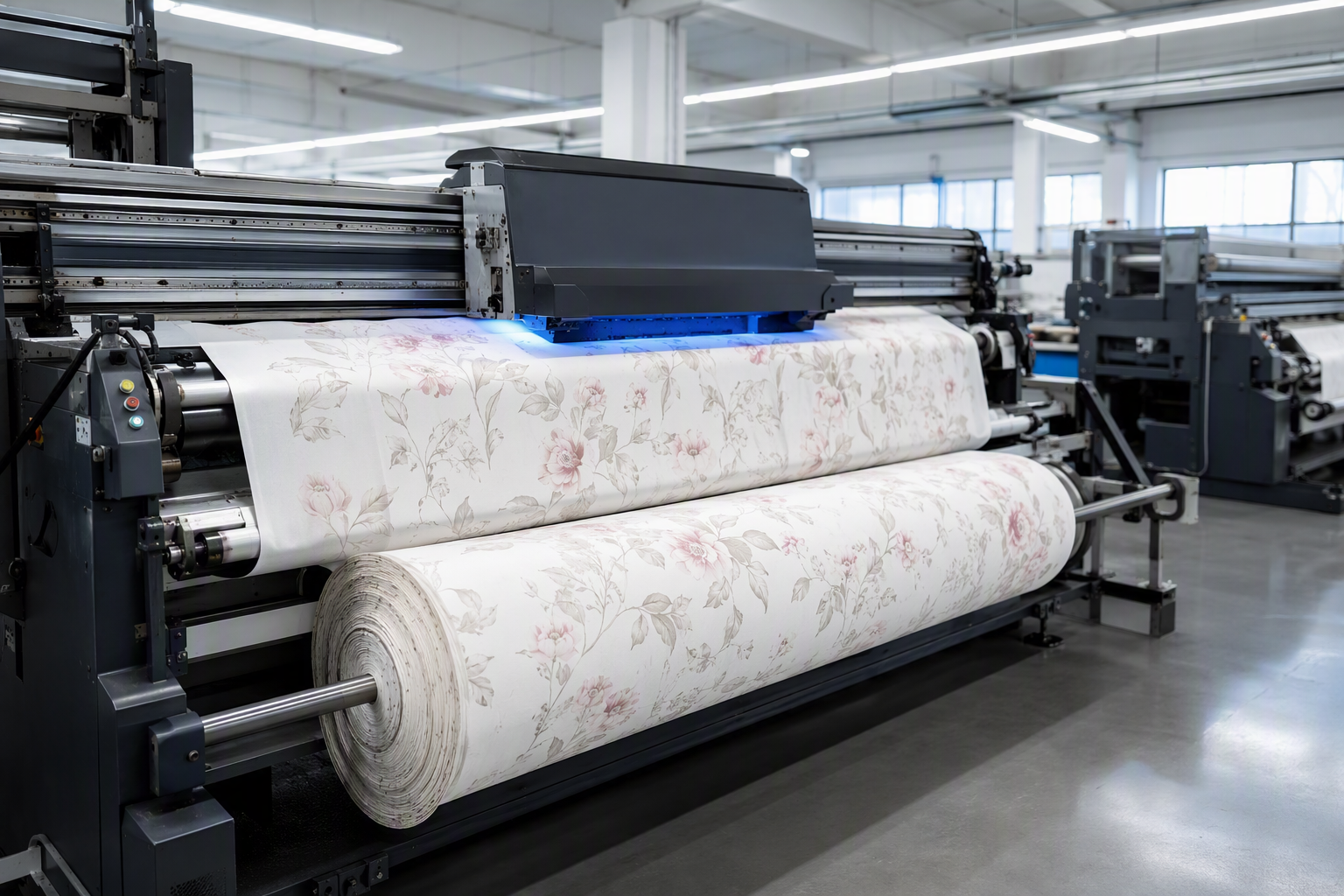
| Dye sublimation | Dyes transferred through heat into the fibres | Full colour, fine detail, photographic | High on polyester — dye is in the fibre | Polyester programs, detailed designs, all-over prints |
| Digital direct | Inkjet dyes printed directly onto fabric | Wide colour range, good detail | Good on natural fibres with the right inks | Design work on cotton and linen, limited runs |
| Screen printing | Inks pushed through a stencil per colour | Strong solids, limited detail per screen | Good — inks sit on or in the surface | Repeats, bold graphics, large runs, single or few colours |
| Transfer print | Printed sheet bonded to the fabric with heat | Varies with the transfer medium | Lower — the layer can crack or peel over time | Low-cost or short runs where wash cycles are limited |
The honest summary: dye sublimation and digital direct put colour into the cloth, screen printing lays a durable film of ink, and transfer printing adds a layer — and the washing behaviour follows from exactly that difference.
3. Durability and Wash Behaviour
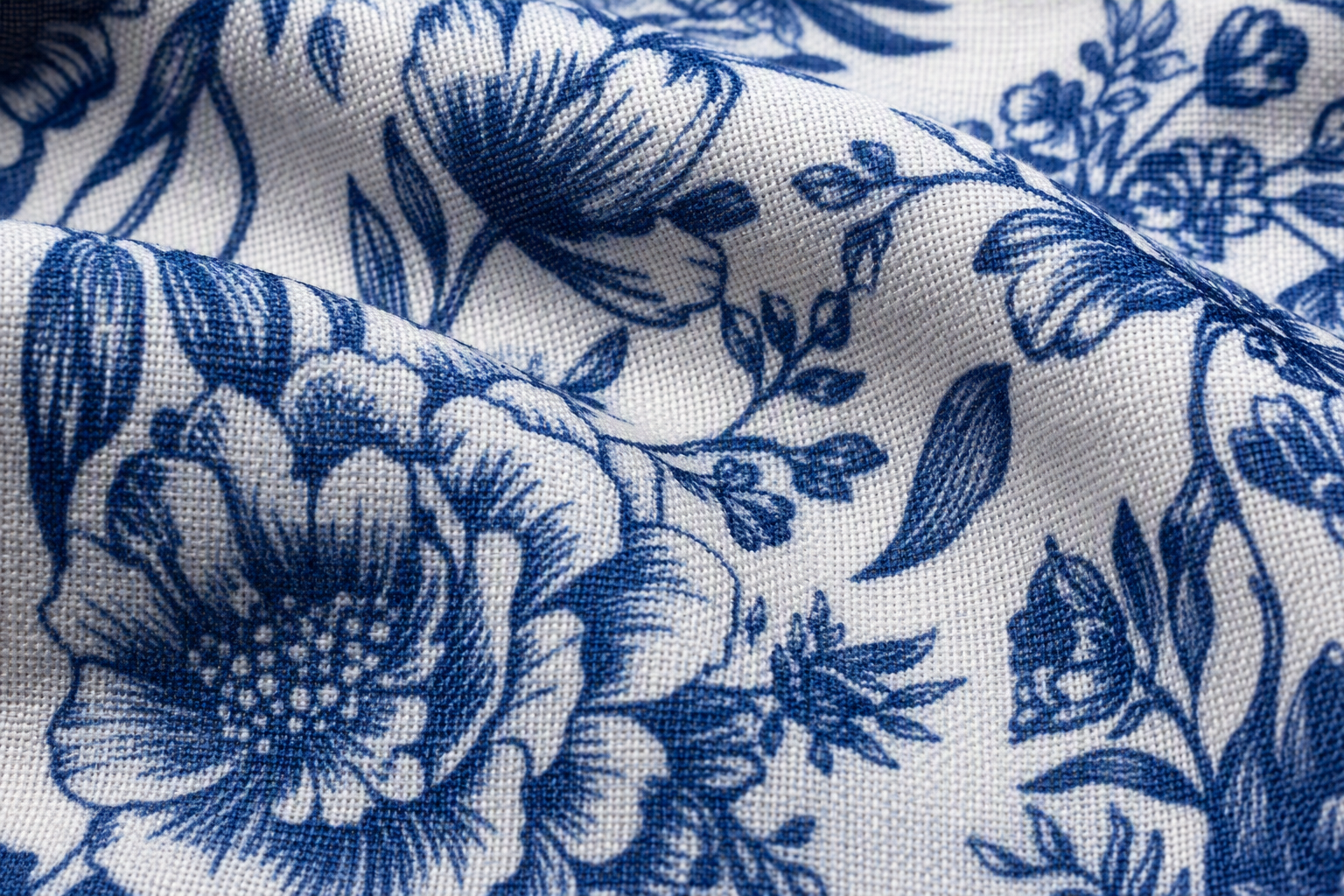
- Match the method to the fibre. Sublimation needs polyester to hold; cotton and linen take digital direct or screen better. A method that is perfect for one fabric can be wrong for the other.
- Ask for wash-rated fastness, not just a sample. The approval sample is wash zero; the program is wash two hundred. Request the colourfastness data for the specific print, and run your own wash test before the full order.
- Watch the three classic failures: fading (dye or ink not rated for the wash temperature), bleeding (loose dye migrating onto white pieces in the same load), and cracking (transfer or stiff inks splitting along fold lines).
- Respect the care limits. Each print has a practical ceiling for temperature and chemical load; the care program should be written to the print’s limits, not to the fabric’s.
- Pre-wash new printed stock before service — the first washes remove any surface looseness and confirm the print’s behaviour in your actual cycle.
4. Design Considerations for Woven Fabric
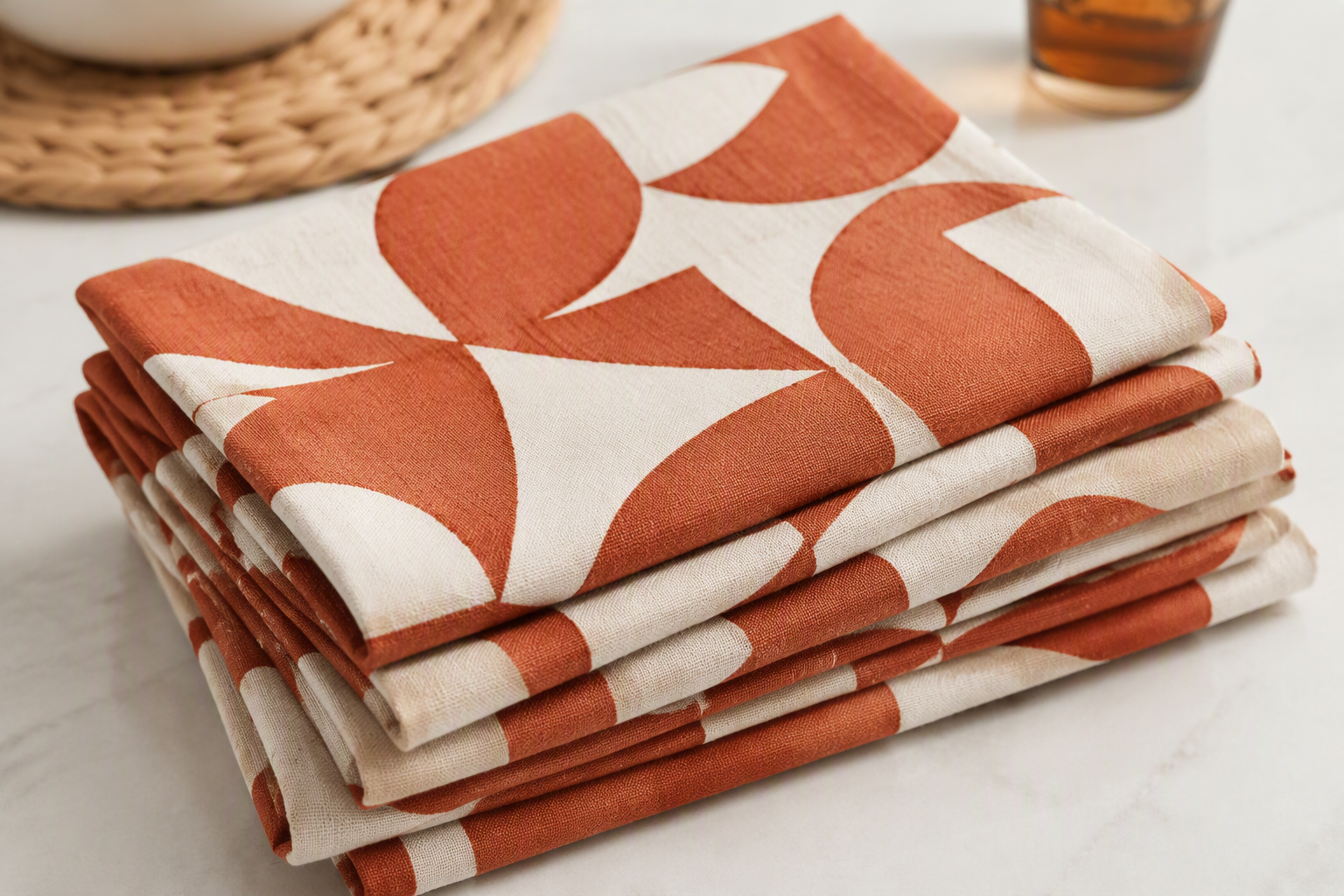
- Design at finished size. A pattern that works on a 30 cm swatch can feel crowded or sparse on an 18″ napkin; the repeat should be scaled to the finished cloth, and approved on a finished piece.
- Consider the fold. Napkins are folded in fixed ways — the design should look right folded, not just flat, and avoid placing key motifs exactly where the fold will cut them.
- Plan the edge. Decide how the pattern meets the edge — cut through, bled to the border, or framed with a clear margin — because the edge finish (mitered, serged, or other) will cover part of the border.
- Test contrast against the base. Dark on white reads crisply; light-on-light needs the method with the best density. Judge contrast in the actual fabric, not a screen mock-up.
- Keep the weave visible where the style wants it. On natural fibres, the texture of the cloth is part of the look — a print method that fills the weave completely can flatten that texture.
5. Printed vs. Embroidered vs. Woven (Jacquard)
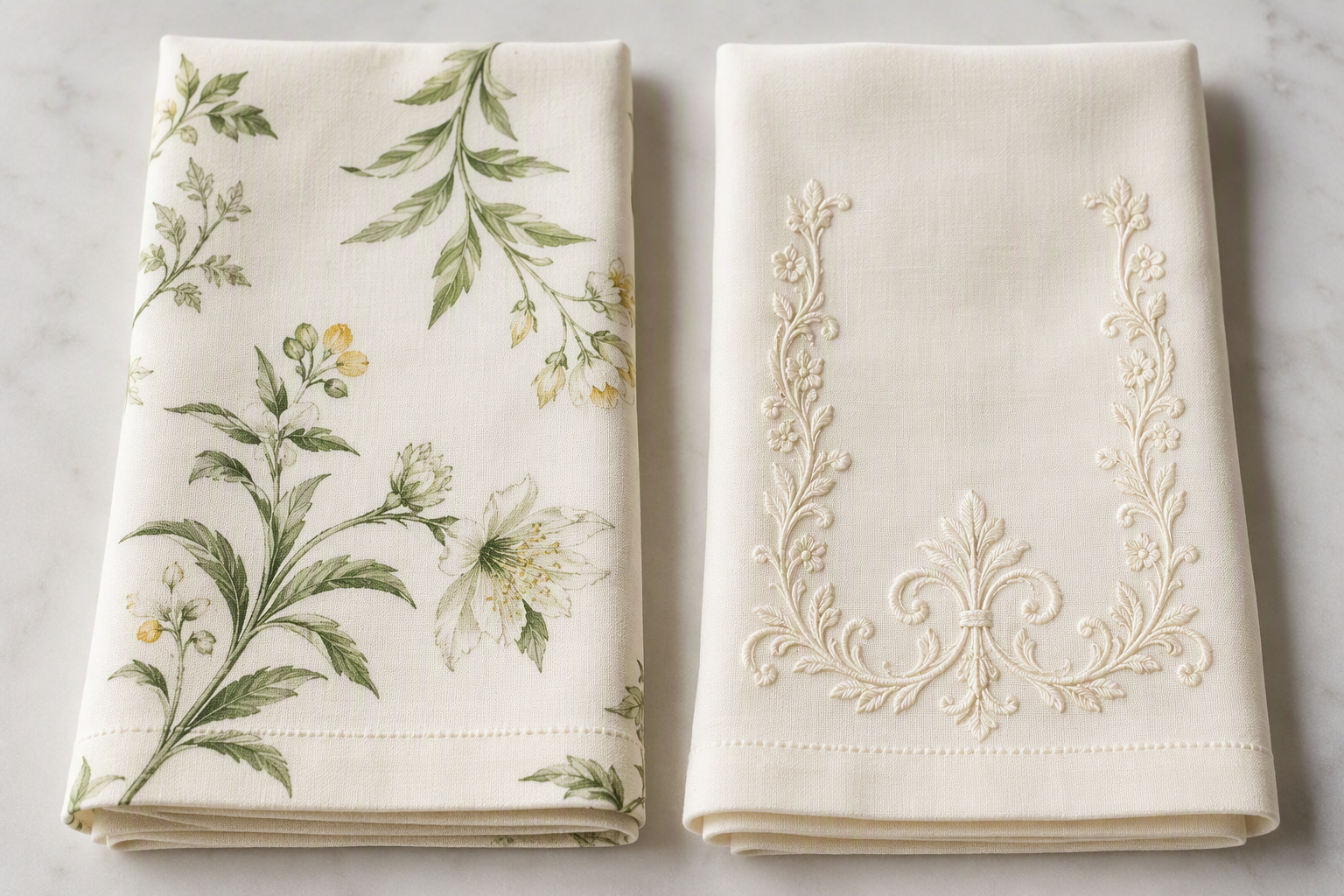
- Print wins on pattern and colour range — all-over designs, multi-colour work, seasonal rotation, and volume cost.
- Embroidery wins on a small, permanent focal point — a monogram, a border, a logo that should outlive the fashion of the programme. Thread sits on the surface and reads as texture; it also takes the mechanical stress of washing directly, so the thread quality matters (we covered that in our embroidery guide).
- Jacquard (woven) wins when the pattern must be part of the cloth itself — woven decoration cannot fade or peel because it is the fabric, at the cost of design complexity and specification lead time.
- They can combine. A printed ground with an embroidered focal point, or a woven cloth with a printed accent, are real program choices — the rule is one decoration doing the structural work and the others doing the visual work.
6. Planning a Printed Program
- Archive the design file and the approved sample together. A print program only reorders cleanly if the exact file and the sealed approved piece are both on file — one without the other is how reorders drift.
- Keep a constant base cloth. Changing the fabric under a pattern is the fastest way to make the same design look like a different product between runs.
- Batch reorders to the original run’s method and supplier process. Even the same file can print differently across methods or suppliers; consistency of process is part of the match.
- Time seasonal prints like other seasonal stock. A holiday print ordered in the holiday has the same production and freight problem as any seasonal linen — the lead time applies to the print program too.
- Agree MOQ and run consistency per design. Small first runs are reasonable for testing; but know the minimum per design and per colour, because each is a separate specification.
7. The Buying Checklist
- Method specified in writing — sublimation, digital direct, screen, or transfer — matched to the fibre.
- Finished-size sample approved, folded, in the venue’s light.
- Wash fastness data for that print, plus your own wash test on the sample before the full order.
- Edge and border treatment defined — how the pattern meets the hemmed edge.
- Design file and sealed sample archived for the reorder.
- Care limits written into the linen program — temperature and chemical ceiling for the printed stock.
8. Printed Napkin FAQs
Which printing method lasts longest in a commercial wash?
On polyester, dye sublimation, because the dye becomes part of the fibre rather than sitting on it. On cotton and linen, digital direct with rated inks or screen printing are the durable options. Transfer printing is the one to treat with the most caution under heavy washing.
Can I print a logo on cloth napkins?
Yes — a logo is one of the most common uses. For a small, permanent mark, embroidery is often the stronger choice; for a full-colour logo or a designed pattern, printing is the practical route. Some programs combine both.
Will a printed napkin match between reorders?
It can, when the same file, the same base cloth, and the same process are used, and when the approved sealed sample is the reference. The match is a managed process, not an automatic result — which is why the archive and the sample both matter.
Is printing more or less durable than the fabric itself?
Usually the print is the more vulnerable part — the cloth outlives a poorly matched print. Choose the method to the fibre and the wash cycle, and the print should hold for the working life of the napkin.
Final Thoughts
A printed napkin program is a specification in three parts: the method matched to the fibre, the design made for the finished cloth and its fold, and the care written to the print’s limits. Get those three right and archive the file and the sample, and a printed program reorders cleanly and stays sharp for the whole life of the stock — rather than fading into a cautionary tale by the second season.
We produce printed cloth napkins in dye sublimation, digital direct, and screen printing — with wash fastness data per design, finished-size samples, and archived files for clean reorders. Contact us for print samples, method guidance, MOQs, and wholesale pricing.